Thursday, October 11, 2007

Sense Amid the Fear-mongering

Every since I heard Bjørn Lomborg interviewed on the radio for his new book, Cool It, I've wanted to check it out. From the Amazon.com review by author Michael Crichton:

Cool It: The Skeptical Environmentalist's Guide to Global Warming will further enhance Lomborg’s reputation for global analysis and thoughtful response. For anyone who wants an overview of the global warming debate from an objective source, this brief text is a perfect place to start. Lomborg is only interested in real problems, and he has no patience with media fear-mongering; he begins by dispatching the myth of the endangered polar bears, showing that this Disneyesque cartoon has no relevance to the real world where polar bear populations are in fact increasing. Lomborg considers the issue in detail, citing sources from Al Gore to the World Wildlife Fund, then demonstrating that polar bear populations have actually increased five fold since the 1960s.

Lomborg then works his way through the concerns we hear so much about: higher temperatures, heat deaths, species extinctions, the cost of cutting carbon, the technology to do it. Lomborg believes firmly in climate change--despite his critics, he's no denier--but his fact-based approach, grounded in economic analyses, leads him again and again to a different view. He reviews published estimates of the cost of climate change, and the cost of addressing it, and concludes that "we actually end up paying more for a partial solution than the cost of the entire problem. That is a bad deal."

In some of the most disturbing chapters, Lomborg recounts what leading climate figures have said about anyone who questions the orthodoxy, thus demonstrating the illiberal, antidemocratic tone of the current debate. Lomborg himself takes the larger view, explaining in detail why the tone of hysteria is inappropriate to addressing the problems we face.

In the interview, which was on Prager's show, he showed himself to be sensible and uninterested in the standard utopianist screeds about who's to blame. Basically he 1) firmly believes that global climate change presents a problem, 2) believes that it is to a great extent caused by human activity and 3) looking at reality, concludes current proposals to address it are wrongheaded. So he separates the facts from the fear-mongering. He gets attacked, of course, for not partaking of the envirofreak koolaid. But he's on Time's influential 100 list, and his detractors are probably out smoking homegrown and griping. This made me laugh:

Lomborg was not the first to say these things, but he hit a nerve. Environmentalists reacted to him in the way that corporate public relations departments had learned not to react to them: by fanning the flames with intemperate attacks. He was vilified in Scientific American magazine. He was found guilty of "scientific dishonesty" by a national committee of Danish scientists (the verdict was later overturned by the academy). With each attack, sales of his book boomed. And try as they might, the critics could not paint this mild-mannered, bicycle-riding, leftish vegetarian as a corporate apologist.

So he's smart, healthy, and these dweebs helped him get rich -- good for him. I'll bet he rides a really nice bike.

As an example of his practical, big-picture view from his radio interview, he agreed that global warming will be a boon to the Anopheles Mosquito, ergo more cases of malaria for those in prone areas. But he points out that in regards to human victims of the disease, poverty will still be a much greater indicator for fatalities than temperature and climate. So resources committed to forcing nations to comply with greenhouse gas emissions standards would be better spent in providing nets and medicines to those potential victims.

But this argument probably only appeals to me because I'm a human who is more interested in helping other, especially poorer, humans than in sticking it to richer humans. If any non-humans, sub-humans, space aliens, human-animal hybrids, envirodorks or anopheles mosquitoes would like to comment, please do so.

Monday, October 8, 2007

"Scribblers" and Scientific Chastity

Oswald Sobrino posts on a book by Sir Karl Popper, The Logic of Scientific Discovery. The book was first published in 1934 and most recently reissued in 2002. Mr. Sobrino provides some excerpts from this edition to "help us keep scientific claims in perspective, especially when those claims are pushed forward by non-scientists." His insightful conclusion:

Popper offers a chastened view of scientific claims that most scientists, I think, share; but that few non-scientists are aware of due to the fact that we are so dazzled, as outsiders, by so much scientific achievement in the modern era. In contrast, we have unrestrained scribblers, usually non-scientists, who do not show the restraint of scientists. Well, we live in a society that is, in many ways, out of control -- temperance or chastity are just not the marks of American culture today. To be chaste is not just a sexual virtue. To be chaste is a virtue of humble restraint needed throughout the culture. The lack of temperance courses through our culture from the highly personal aspects of life to the highly public claims of pseudo-scientists. Maybe, there is a testable link.

What would be an example of this kind of link? Could one be a link between people who are into "free love" and, like, totally freaked out by man-made global warming? Maybe... I don't know if it's testable; I'm a non-scientist. But I'm not sure if it really needs to be tested either.

Sunday, October 7, 2007

More Red Mass Hysteria

By way of Roger at Catholic Lawyer, we see another frowny-face made at the Red Mass, this one from a secularist point of view. The first attack I saw mainly focused on the scary guns and patriotic music. (I highly recommend the comments in that one if you are in need of a laugh.) Excerpt:

The homily, or sermon, was delivered by Archbishop Timothy Dolan of Milwaukee. Archbishop Dolan characterized the event as an opportunity "to rejoice in a mutually enriching alliance between religion, morality and democracy." But what he meant, of course, was that we should rejoice in an alliance between a particular religious denomination, Catholicism, and the government. This was no celebration of religion as a general matter.

I'm glad Ms. Hamilton is around to educate us on what the Archbishop really meant.

I welcome substantive discussion of why you think either of these viewpoints is right, wrong, thoughtful or stupid, especially from those readers with law degrees. As a mere layman, I'll just list three things that these reactions remind me of:

1) The widely reported recent Mass at which the Pope "intentionally wore Green vestments", ostensibly to make an environmental statement.
2) Bill Murray's character in the movie Ghostbusters warning of the possibility of "dogs and cats living together and mass hysteria" if they didn't stop the evil spirits.
3) The Spanish Inquisition's use of a "comfy chair" to torture a little old lady on an episode of Monty Python's Flying Circus.


Shocking.

Saturday, October 6, 2007

Tintoretto

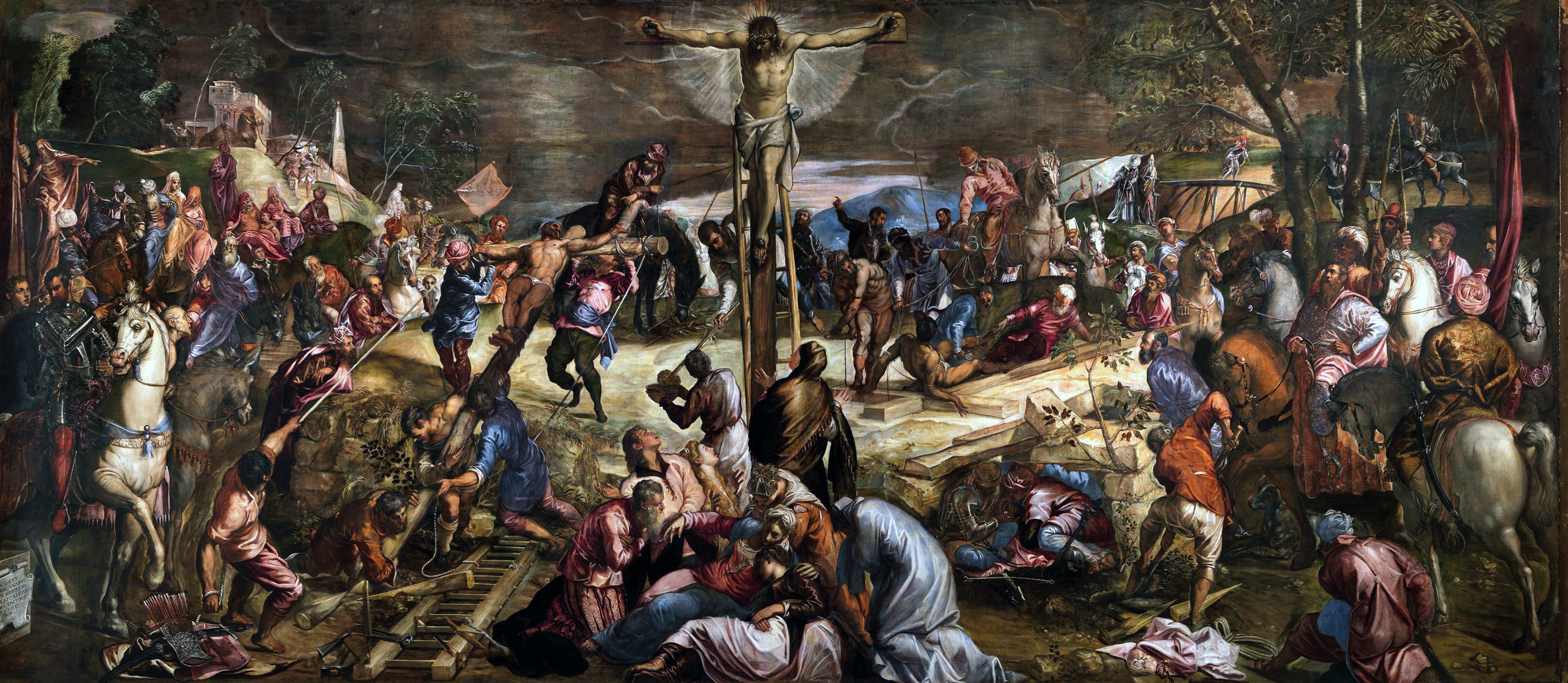
Kathleen pointed out this WSJ article to me several weeks ago about the great Venetian artist Jacopo (Robusti) Tintoretto. He painted incredible scenes from the life of Christ, the Blessed Virgin and the lives of the saints back in the late Renaissance at the Scuola Grande di San Rocco where he met with tons of jealousy and resentment from his colleagues. I found the images I posted here, which are merely details of a few works, on a Brown University page. Anyway, the article is written by James Panero from the New Criterion who has a blog post referencing the WSJ piece. Clicking on the image of the crucifixion on his post will take you to an enormous image file that you have to scroll around on to check out the entire work. Here's an excerpt from Panero's WSJ article:

Within a year, Tintoretto overcame the Scuola's lingering resentment; he was accepted for membership and allowed to attempt his great "Crucifixion."

The layout of the room posed several challenges. Three different architects worked on the Scuola's design. When it was finished by Scarpagnino in 1549, the building's small, elevated windows provided only minimal interior light. The albergo was also wider than it was long, so that any painting covering the back wall would have to be viewed from close proximity and below.

Tintoretto conceived of a revolutionary program. Rather than keep his design locked in strict perspective, which would have been distorted by the room's oblique points of view (think of the front row of a movie theater), Tintoretto folded his narrative around the central figure of Christ on the cross. He then depicted Christ bending down -- to address the good thief, the figures in mourning at the foot of the cross, and our gaze from below. The fixity of the cross provides an anchor within an undulating sea of dark details that seems to extend beyond the picture plane out into our own space. With blank faces, the mundane figures surrounding Christ stir up the awful scene. A crowd of onlookers, carpenters, soldiers and even a dog make up "a centrifugal energy that charges the entire picture," as the art historian David Rosand wrote in his survey of 16th-century Venetian painting.


The ominous tones, curved landscape and artistic urgency that underlie Tintoretto's color choice, composition and paint handling make this work a point of departure. Rather than look back to the neo-Platonic ideals of classical sculpture -- brilliantly embodied at the start of the 16th century in the ceiling frescoes of the Sistine Chapel -- Tintoretto's "Crucifixion" anticipates the fallen angels of our modern era.

Like a thunderbolt from the brush, Tintoretto's "Crucifixion" can stop you in your tracks. The Victorian writer and artist John Ruskin certainly thought so. "I have been quite overwhelmed today by a man I have never dreamed of -- Tintoret," he wrote to his father on his first visit to Venice. "I always thought of him a good and clever and forcible painter, but I had not the smallest notion of his enormous powers. . . . And then to see his touch of quiet thought in his awful crucifixion -- there is an ass in the distance, feeding on the remains of strewed palm leaves. If that isn't a master's stroke, I don't know what is."

The Scuola has a page you can check out with a lot of images. Here's another great painting of the Annunciation. Looks like a freeze frame from a great action flick with the Holy Spirit beating St. Gabriel by a nose.


"St. Mark rescuing the beggar" also has a great action feel. There always seems to be a feel of an invasion by the forces of heaven into the earthly realm. (Yo, that's deep, dude.)


Thanks for reading my blog. For current commentary and what-not, visit the Est Quod Est homepage

Thursday, October 4, 2007

The Primaries vs. The Tertiaries

This kind of clear thinking is an example of why I was proud to work on Ken Blackwell's gubernatorial campaign and hope to do so again. Excerpt:

If social conservatives disagree with Mr. Giuliani they should work to beat him in the primaries. Why the allure of the quixotic "third party" rather than a real, principled primary fight? If the issues are life, marriage, and Second Amendment freedoms, and the objective is to win, a good bet seems to be Mike Huckabee. He is right on these issues. And, he has been highlighted by pundits on all sides as the one to watch for a breakthrough.

Emphasis mine. All these people that think the objective is to "send a message" about what you think about the so-called establishment, they should write a letter or make a phone call. Those are the ways that normal people "send a message". You don't send a message by losing except for, maybe, "WE LOST LIKE WE KNEW WE WOULD -- AREN'T WE GREAT?"

Wednesday, October 3, 2007

The Soft Bigotry of Believing a Liar

Matthew J. Franck on Ruth Marcus's continued belief of the Anita Hill fabrication.

Ruth Marcus's accusation of anger on the part of Justice Thomas is typical liberal feminist projection. Unless she's playacting herself, I don't know what to call Marcus's continued belief of this poster child for the continued practice of black slavery by liberal Democrats.

Wednesday, September 26, 2007

Pauli blows chance to get on TV by being his usual laconic, abrasive, sarcastic self

I probably won't make the evening news since I'm such a smart-ass, but honestly I hadn't even heard of the big pope euthanasia rumor. I was approached by a channel 19 news-chick going up the steps of St. John's at Noon today. It went kind of like this:

news19chick: Excuse me sir... I know mass is starting... have you heard about the story... I mean you're a good Catholic, right?... the Roman Catholic church claims to be against euthanasia... an Italian physician said the Pope didn't have to die.... what do you think?

pauli: Sounds like Godfather three.

cameraman: [laughs]

news19chick: uhh... O... K... more... give me more, I need more, can you give me more thoughts....

pauli: Well, I thought the first two Godfather films were a lot better.

I then turned around and went into the cathedral for Mass. Like I said, I doubt they'll run that.

I try to look on the bright side of things. At least she's not out making porno movies.

Father Jonathan deals with the whole non-story here in a more substantive way than I did.


Mr. Coppola, I hate to tell you this, but your beard could have done a better acting job than your daughter.

UPDATE: Finished watching the channel 19 news at 11PM and they ran the story about the Italian doctor, the feeding tube, blah, blah, blah... but they didn't show anyone they man-in-the-street-interviewed. That's funny because they hung around outside the Cathedral all through Mass and were there interviewing 3 or 4 people when I was on my way to lunch with a friend. We were laughing; obviously the daily Mass crew isn't composed of the types to say "No... really? You don't say! Wow! I knew Pope John Paul II was a big hypocrite!"

Platonic Paulihedra

You can't make anything up anymore. Like for instance, I was just in the men's room polishing my head with a damp paper towel when I imagined an internet quiz called "Which regular polyhedron are you?" This caused me to chuckle about how clever and original my ideas are.

Precautionary googling revealed that of course, such a thing already exists, duh.

I guess the "cat's out the bag" as they say in my old nabe. I'm a D&D-style geek. But the odds of my readers not picking that up by now are approximately the same as successfully navigating an asteroid field, i.e., 3,720 to 1. That's equivalent to rolling a 7 on a dodecahedron 310 times in a row.

I am a d12


So what do you think? Is the quiz accurate? I'm especially anxious to read Tom's assessment of this quiz.

"You are the rare, the overlooked, yet incredibly useful dodecahedron: the d12. You are a creative, romantic soul. You often act without thinking, but make up for your lack of plans with plenty of heart. You easily solve problems that stump others, but your answers tend to put you into even deeper trouble. You write long, detailed backgrounds for all your characters, and are most likely to dress up as one or get involved in cos-play. You can be silly at times and are easily distracted by your own day dreams, but are at the end of the day you're someone who can be depended on."

Doesn't mention that I can be duplicated by an old 6-sided die and a coin toss, heads add six. So much for "incredible usefulness."